
What Is Somatic Therapy? Understanding the Mind-Body Connection in Stress, Anxiety, and Trauma
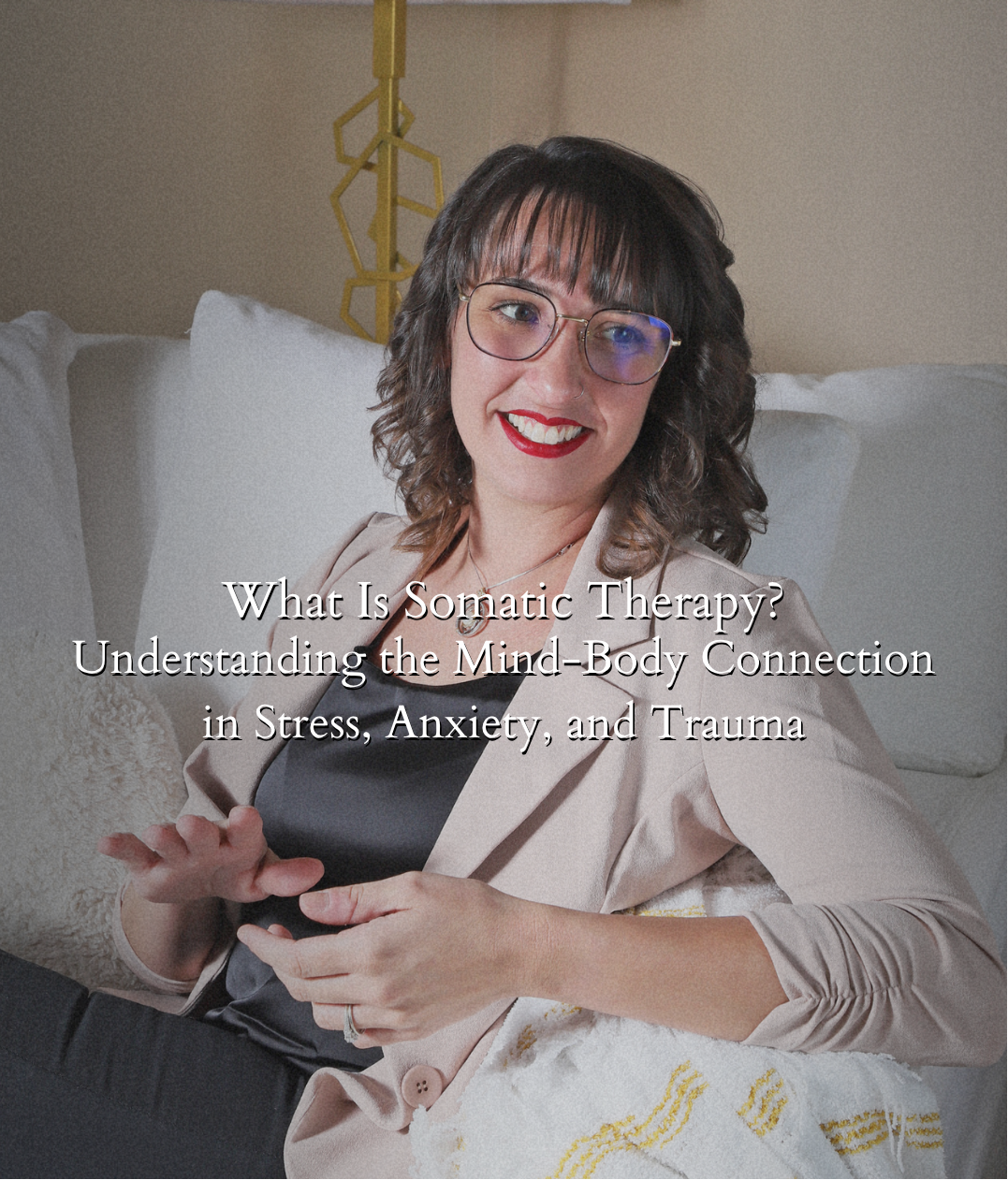
Rebecca Booth, MSW, CAC, CRRA, CSTFP, a somatic trauma-focused practitioner at Nova Counseling Services in Stuart, Florida, seated in a welcoming therapy office. The image accompanies an educational article exploring somatic therapy, the mind-body connection, nervous system responses, and how body awareness can support emotional regulation in individuals experiencing stress, anxiety, and trauma.
Have you ever known that you were safe, yet your body seemed unconvinced?
Maybe your chest tightened before a difficult conversation. Your stomach dropped when you received an unexpected message. Your shoulders stayed tense long after a stressful moment had passed.
Or perhaps your response looked completely different. Instead of feeling visibly anxious, you felt heavy, numb, disconnected, exhausted, or unable to move when you became overwhelmed.
These experiences highlight something many people discover in therapy: understanding a situation intellectually does not always immediately change how the body responds to it.
Sometimes the mind recognizes that a threat has passed while the body is still reacting to stress.
Somatic therapy works with the connection between thoughts, emotions, physical sensations, and nervous-system responses.
Rather than focusing only on thoughts, memories, and emotions, somatic therapy also pays attention to what happens physically when we experience stress, including changes in breathing, muscle tension, posture, heart rate, movement, temperature, pressure, heaviness, and other internal sensations.
The goal is not to analyze every physical sensation or assume that every symptom has a psychological cause. Instead, somatic work helps people become more aware of how their bodies respond to stress and develop greater flexibility in how they respond.
What Is Somatic Therapy?
Somatic therapy is an integrative approach to psychotherapy that incorporates body awareness alongside thoughts, emotions, behaviors, relationships, and life experiences.
The term somatic comes from the Greek soma, meaning “body.”
In traditional talk therapy, you might explore what happened, what you thought about the experience, what beliefs developed from it, and how those beliefs affect you today.
Somatic therapy can include all of those elements while adding another important question:
What is happening in your body right now as you talk about this?
A therapist might invite you to notice whether your breathing changes, your shoulders lift, your jaw tightens, or you experience pressure, warmth, heaviness, tension, numbness, or an urge to move away from a particular topic.
These sensations are not automatically treated as problems to eliminate. Instead, they can provide additional information about what you are experiencing in the present moment.
The somatic framework used at Nova Counseling Services emphasizes body awareness, nervous-system regulation, embodied emotional experience, and the integration of felt experience alongside verbal processing.
Why Does the Body Matter in Therapy?
Stress does not occur only in our thoughts.
When we perceive something as threatening, uncertain, overwhelming, or emotionally significant, the body can respond automatically.
Your heart may beat faster.
Your breathing may become more shallow.
Your muscles may tighten.
Your stomach may feel unsettled.
You may feel restless or experience a strong urge to leave, avoid, defend yourself, or take immediate action.
In other situations, stress may feel less activated and more like heaviness, exhaustion, emotional numbness, disconnection, or shutdown.
These physical responses can become noticeable before we have consciously made sense of what is happening.
That is one reason someone can genuinely think:
“I know I'm okay.”
While still experiencing a racing heart, tight chest, unsettled stomach, or a strong urge to escape.
Somatic therapy helps bring attention to that gap without assuming that the body is irrational or that the thinking mind is unimportant.
Both are part of the experience.
Sensing Versus Making Sense
Consider receiving a short email from your supervisor:
“Can we talk?”
Nothing else is provided.
You immediately notice your stomach tighten.
Your shoulders rise.
Your breathing changes.
Then your thoughts begin:
Did I do something wrong?
Am I in trouble?
What did I miss?
Somatic work can help slow this sequence down.
Instead of immediately trying to determine what the sensation means, you might first notice:
My stomach tightened.
My shoulders lifted.
My breathing became shallow.
I want to avoid looking at the email again.
This reflects an important distinction between sensing and making sense.
Sensing involves noticing what is happening in the body.
Making sense involves interpreting, explaining, predicting, or assigning meaning to the experience.
Both processes are useful.
The difficulty arises when interpretation happens so quickly that we never notice the physical response underneath it.
A person may move from a tight stomach directly to:
Something is wrong.
A racing heart may become:
I cannot handle this.
Muscle tension may become:
I need to get out of here.
Somatic therapy does not ask people to stop thinking. It helps create enough space to notice what is happening before automatically deciding what it means.
What Is Interoception?
One concept often used in somatic work is interoception, or interoceptive awareness.
Interoception refers to our ability to sense internal conditions of the body, including signals related to heartbeat, breathing, hunger, fullness, and other physiological states.
More broadly, somatic awareness can also include noticing muscle tension, posture, movement, temperature, pressure, and other bodily sensations.
Some people notice these signals easily.
Others may not recognize that they are becoming activated until the response is already intense.
Someone may not notice how tense their shoulders are until they develop a headache.
They may not realize they have been holding their breath until they suddenly sigh.
They may not recognize how distressed they are during conflict until they are already yelling, crying, withdrawing, or shutting down.
Increasing body awareness can create an earlier opportunity to respond.
Instead of recognizing distress when it has reached a nine out of ten, someone may gradually begin noticing it at a four.
That earlier awareness can create more choices.
One concept often used in somatic work is interoception, or interoceptive awareness.
Interoception refers to our ability to notice internal signals from the body, including breathing, heartbeat, muscle tension, hunger, fullness, temperature, pressure, and other physical sensations.
Some people notice these signals easily.
Others may not recognize that they are becoming activated until the response is already intense.
Someone may not notice how tense their shoulders are until they develop a headache.
They may not realize they have been holding their breath until they suddenly sigh.
They may not recognize how distressed they are during conflict until they are already yelling, crying, withdrawing, or shutting down.
Increasing body awareness can create an earlier opportunity to respond.
Instead of recognizing distress when it has reached a nine out of ten, someone may gradually begin noticing it at a four.
That earlier awareness can create more choices.
How Stress Can Shape Body Responses
Stress responses are often associated with obvious danger, but nervous-system activation can also occur during ordinary experiences such as criticism, uncertainty, interpersonal conflict, work pressure, financial stress, relationship tension, or reminders of difficult past experiences.
For some people, stress produces greater activation. They may experience increased alertness, racing thoughts, rapid breathing, tension, gastrointestinal discomfort, or a strong urge to act or escape.
For others, overwhelm may produce a more immobilized response. They may feel heavy, emotionally numb, exhausted, disconnected, slowed down, or unable to take action.
Neither response necessarily tells us exactly why someone is reacting.
It does, however, give us information about what their system is experiencing.
Somatic therapy can help people become more familiar with these patterns, recognize them earlier, and respond with greater choice.
Can the Body “Hold” Trauma?
One of the most common phrases associated with somatic therapy is that “the body holds trauma.”
That phrase can be meaningful, but it can also be misunderstood.
It does not mean that trauma is literally stored inside a particular muscle, organ, or area of the body.
Rather, difficult or overwhelming experiences can influence patterns of responding to later situations.
Certain environments, relationship dynamics, sounds, physical sensations, movements, or interpersonal cues may later evoke a strong stress response, even when the present situation is different from what happened before.
For example:
Someone who spent years needing to remain alert may find relaxation strangely uncomfortable.
Someone who experienced unpredictable conflict may become highly activated during relatively minor disagreements.
Someone who learned to cope by emotionally shutting down may continue becoming numb or disconnected when overwhelmed.
In this sense, the body can become part of a learned pattern of responding and protection.
Somatic therapy helps bring those patterns into awareness so that a person has more opportunity to respond differently in the present.
What Happens During Somatic Therapy?
Somatic therapy does not necessarily involve dramatic exercises or reliving traumatic experiences.
Much of the work can be subtle.
A therapist might invite you to:
Notice where you feel an emotion in your body
Observe changes in your breathing
Track how a sensation shifts over time
Experiment gently with posture or movement
Practice grounding
Notice what helps you feel more settled or present
Explore what happens physically while discussing a particular experience
Some somatic approaches may also incorporate breathwork, intentional movement, mindfulness, or guided awareness exercises.
Somatic work should be collaborative and paced according to each person's comfort, with opportunities to pause, redirect attention, or return to verbal processing when needed.
The goal is not always to make an uncomfortable sensation disappear.
Instead, the work may involve developing a different relationship with the sensation.
Rather than immediately fearing, suppressing, judging, or escaping it, someone may gradually learn to recognize:
Something is happening in my body.
I can notice it without immediately deciding what it means.
I can explore what may have activated me.
I have choices in how I respond.
That shift can be important because fear of the sensation itself can sometimes add another layer of distress.
Somatic Therapy Does Not Replace Thinking
Somatic therapy is sometimes misunderstood as though thinking is the problem and the body contains the “real” answer.
That is not the goal.
Thoughts matter.
Beliefs matter.
Relationships matter.
Behavior matters.
Personal history matters.
The body simply provides another source of information.
For many people, cognitive strategies are highly useful. Changing beliefs, challenging distorted thinking, improving problem-solving, or understanding patterns can lead to meaningful change.
But there may also be moments when someone understands something logically while continuing to experience a strong physical or emotional response.
You might know that you are not responsible for everyone else's feelings and still experience intense guilt when you set a boundary.
You might know that your current relationship is different from one that hurt you in the past and still notice your body preparing for rejection.
You might understand that a panic sensation will pass and still feel frightened when it begins.
Somatic therapy can complement cognitive, relational, and trauma-informed approaches by including what is happening physically as part of the therapeutic conversation.
What Can Somatic Therapy Help With?
Somatic approaches may be incorporated into therapy for concerns involving:
Anxiety
Trauma-related symptoms
Chronic stress
Emotional dysregulation
Relationship patterns
Difficulty identifying emotions
Shutdown responses
Feeling disconnected from the body
Somatic therapy may particularly resonate with people who find themselves saying:
“I understand why I feel this way, but understanding it hasn't changed it.”
“My body reacts before I know what I'm upset about.”
“I feel anxious, but I don't always know why.”
“I shut down during conflict.”
“I can't seem to relax even when nothing is wrong.”
“I feel everything in my chest or stomach.”
These experiences do not automatically mean someone needs somatic therapy.
No single therapeutic approach is appropriate for everyone, and evidence of effectiveness varies among somatic approaches and the concerns being treated. Therapy should be individualized according to a person's concerns, preferences, history, and goals.
Awareness, Not Hypervigilance
Body awareness can be helpful, but somatic therapy is not about constantly scanning yourself for signs that something is wrong.
That distinction matters.
For someone who already feels highly anxious about physical sensations, excessive monitoring can become another source of distress.
The goal is not:
“What is my body doing now? What does that mean? Is something wrong?”
The goal is greater flexibility.
Muscle tension can become something to notice rather than automatic proof that danger is present.
A change in breathing can become a cue to pause rather than something that must immediately be eliminated.
A familiar stress-related sensation may become an opportunity for curiosity rather than an immediate reason for alarm.
At the same time, physical symptoms should not automatically be attributed to stress or anxiety. New, severe, persistent, or unexplained symptoms may require medical evaluation. Sudden or severe chest pain, particularly when accompanied by shortness of breath or other concerning symptoms, warrants immediate medical attention.
When a physical sensation has been appropriately evaluated, the therapeutic process may involve shifting from:
“My chest is tight. Something must be wrong.”
To:
“My chest feels tight. Let me notice what was happening when that changed.”
That small shift creates space between the physical sensation and the interpretation attached to it.
Within that space, there may be more room for curiosity, regulation, and choice.
Your Body Is Part of the Conversation
We often think of therapy as gaining insight, understanding the past, changing thoughts, or developing new behaviors.
Those things matter.
But many experiences are not only understood intellectually. They are also felt emotionally and physically.
Somatic therapy expands the conversation.
It asks not only:
What happened?
and
What are you thinking?
but also:
What is happening inside you right now?
Learning to recognize these responses can help people better understand the relationship between their thoughts, emotions, behaviors, experiences, and nervous system.
Somatic therapy invites both parts of the experience into the room: the thoughts that help make sense of what happened and the bodily responses that continue to shape how it feels.
Sometimes healing begins with insight. Sometimes it begins with awareness. Often, it involves both.
Frequently Asked Questions About Somatic Therapy
-
Research on somatic approaches continues to grow. Some body-based therapeutic approaches have been studied for trauma, anxiety, stress, and emotional regulation, although the strength of the evidence varies depending on the specific method.
Somatic techniques are often used alongside established psychotherapy approaches rather than as a replacement for them.
-
Traditional talk therapy primarily focuses on thoughts, emotions, behaviors, relationships, and experiences.
Somatic therapy includes those elements while also paying attention to body awareness, physical sensations, and nervous-system responses.
-
Somatic approaches are often incorporated into anxiety treatment because anxiety commonly involves both cognitive and physical responses, such as muscle tension, shallow breathing, increased alertness, restlessness, and gastrointestinal discomfort.
-
Somatic approaches are often incorporated into trauma treatment because trauma can affect both emotional and physical responses to stress. Somatic therapy may help people become more aware of nervous-system responses, physical sensations, and patterns of activation or shutdown that occur during stressful experiences.
-
Not necessarily.
Somatic therapy does not always involve discussing traumatic events in detail. Many approaches can focus on present-moment experiences, body awareness, nervous-system regulation, and developing greater capacity to respond to stress.